
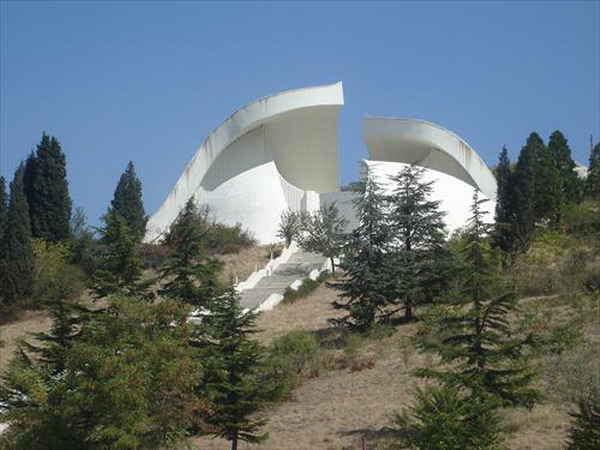
Devotees of the Partisan struggle in Yugoslavia are angry that the monuments commemorating the era are falling into neglect in the very different circumstances of modern Macedonia.
The controversy is even more pronounced as a result of the fact that the right-wing VMRO-DPMNE-led government of Nikola Gruevski is spending vast sums on erecting monuments of a very different kind.
Gruevski’s pet project, dubbed “Skopje 2014”, is a grandiose bid to refurbish Skopje’s dull central area with art and architecture drawing inspiration from the time of Classical Antiquity.
The amount being spent on Classical-inspired monuments to the likes of Alexander the Great and Philip of Macedon is being measured in hundreds of millions of euros.
Meanwhile, despite its historical significance, the World War II museum in the central town of Prilep is a virtual ruin.
Broken ceilings, walls decayed by damp and dangers of power surges are only some of the problems plaguing the site.
The museum stands on the site where, on October 11 1941, Macedonian resistance fighters fired the first shots against the Bulgarian occupation forces who were using it as prison and a police station. This event is commemorated as the start of Macedonia’s national liberation struggle.
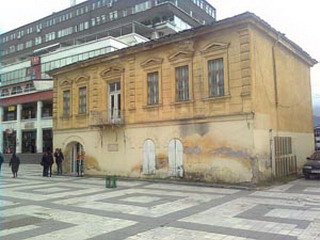
Owing to extensive damage, the museum has been closed to visitors for an entire year. The authorities have yet to find the estimated 100,000 euros to fix it.
Another example of official negligence is the memorial house to the Second World War in Veles, which has been mouldering for decades. The building suffers from so much damp that some fear it might soon crumble completely as a result of the heavy moisture.
A once modern structure, constructed 30 years ago, it boasts Macedonia’s largest complete mosaic, a three-year effort by artist Petar Mazev.
The structure also contains the remains of Koco Racin, one of most celebrated Macedonian poet-revolutionaries of that era, as well as those of hundreds of other revolutionaries.
For eight years officials have repeatedly announced the imminent reconstruction of the almost collapsed structure, but little has been done.
The extensive historical exhibition of the Partisan movement at Prilep is little better off.
Comprising photographs, documents, sketches, weapons, munitions and newspaper excerpts from the Partisan era, it also contains a large fresco and mural devoted to the Partisan movement.
“Nothing has been refurbished for over 28 years and the facility is in a desperate condition,” says museum director Gordana Danilovska-Spirovska, adding that the valuable collection is under existential threat from the poor atmospheric conditions.
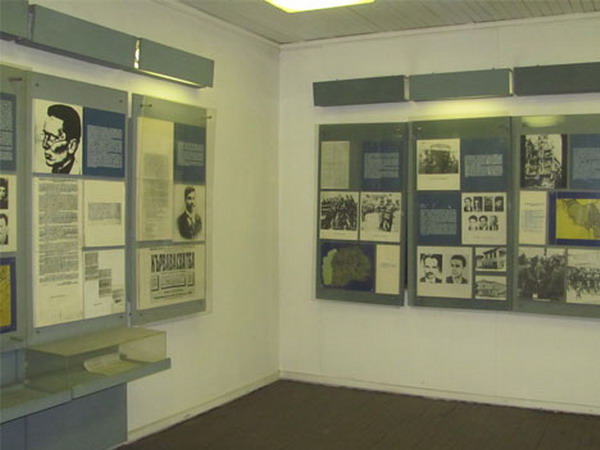
“To stop its further decay and revive its former condition the whole place urgently needs renovation of the interior as well as a complete architectural rebuild,” Spirovska says.
The Ministry of Culture recently allocated 30,000 euros for renovation work, which is a start, though less than half of the sum needed.
“We envisage reconstructing this monument as soon as possible. It will be a great contribution to the preservation of memorial monuments, and to the development of cultural tourism,” culture minister Elizabeta Kanceska-Milevska said recently.
“We’re allocating money for this and many other projects for this area and for the rest of the country as well,” the minister added.
The directors of the Memorial House in Veles, meanwhile, still await signs of official concern.
“There is no electricity supply and no staff to take care of the premises,” the historian and current manager, Marin Klifov, says.
“Only one of the nine staff originally employed here continues working,” he adds. “Thefts happen on daily, so we’ve stored away some of the more significant artifacts,” Klifov complains.
Municipal officials in Veles are strong on words, but promise little action, freely admitting that theft from the site has become endemic.
“It would be a shame if the house, with all its value, remained unprotected. Not only is time taking its toll but abuse by unscrupulous citizens is also contributing to its demise,” the office of mayor Goran Petrov told Balkan Insight.
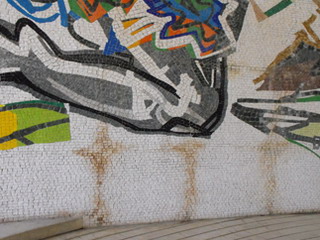
Veles officials confess that locals routinely rob the site, selling the metal they steal to nearby junkyards. Officials say they will address this issue by installing video cameras around the site next year.
In the meantime, Katica Cadieva, head of culture at Veles municipality, says they are urging locals “not to buy chunks of iron stolen from monuments and museums and to report them to us.
“However, unscrupulous thieves find buyers [for the stolen metal] in other towns,” she notes.
Veles veterans from the war have repeatedly written to the Ministry of Culture, demanding immediate action before it is too late.
“This is where Macedonian history breathes and is a resting place for the bones of those who sacrificed their lives for us,” one protest letter from Veles veterans reads.
The local branch of the main opposition Social Democrats says Gruevski’s right-wing VMRO DPMNE party has deliberately neglected Partisan-era monuments since it took power in 2006.
“We should be proud of our history and not deny it like the authorities do,” Dejan Arsovski, President of the local club of young Social Democrats, said.
The club last year organized a cleanup of the Veles memorial house and other wartime monuments in the area.
Macedonian’s ruling party, formed in the early 1990s as a revival of an Ottoman-era independence movement, has an ambiguous attitude towards the Partisan era.
They acknowledge that the Partisans liberated Macedonia – and Yugoslavia – from German occupation, but condemn the way they then plunged the country into a Communist straightjacket.
The director of Macedonia’s National History Institute, historian Todor Cepreganov, doubts that the negligence of Partisan monuments is especially politically motivated.
He says the country has a regrettably casual attitude to all its history.
“Monuments are only decorated, polished and painted if there happens to be a celebration or a feast nearby, after which they are immediately forgotten until the next jubilee or celebration,” Cepreganov says.
“This is how we treat our own history. We have a sloppy attitude towards those generations who brought freedom to our people,” Cepreganov told Balkan Insight.
“Unless we hand on memories to the next generation, our history will be irreversibly lost,” Cepreganov warns.
Others blame the parlous situation facing many historic monuments in Macedonia on the economic crisis and budget cuts.
“The budget allocated for monuments is far too low to cover all the expenses needed for their protection,” says Zoran Georgiev of the Culture Heritage Protection Office. “The economic crisis is taking its toll.”
This article is funded under the BICCED project, supported by the Swiss Cultural Programme.
 The Espresso Stalinist