
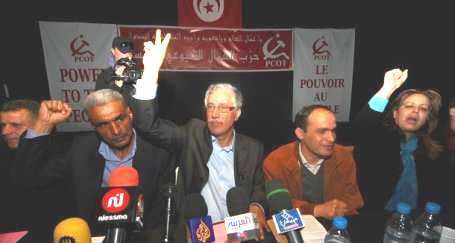
The overthrow of dictator Ben Ali
We are in the midst of a revolution, that is, the revolution continues. On January 14, the people overthrew the dictator Ben Ali after a month of heroic struggles. We got rid of the dictator, but not the dictatorship,that tries to rebild itself, in the legal proceedings in the Parliament and in the Senate, in the state apparatus and especially in the police, ultimately, around the bureaucratic apparatus.
The Tunisian people are not yet freed from social and economic suffocation exercised by a bourgeois minority. I mean, after the fall of Ben Ali, the government remained composed by elements of the apparatus of the dictatorship and the party of the dictator. This government added some members of the reformist and liberal opposition, mainly of two parties, the old revisionist party, that became a reformist party, which came to collaborate with Ben Ali, and the pseudo-liberal party called the Democratic Progressive Party (DPP) forming a so called “Goverment of National Unity”.
So the struggle continued against the government of “national unity” led by the former Prime Minister of Ben Ali, Gannouchi. But this government could not resist the advance of popular struggle and fell two weeks after Ben Ali ran away.
The same prime minister Gannouchi formed a new government. It was essentially a reactionary government, protecting itself few reforms. We won some space for freedom of expression, assembly and demonstration. We built centers of people’s power, the “Meetings for safeguarding the revolution.” Those new organs are each day getting more organised and already managed to impose some claims to the goverment.
Moreover, the revolutionary movement, popular, becomes more radical and demands a democratic republic. In March, the confrontation between the popular movement and the provisional government increased. The movement launched the watchwords of ”defeating the interim government”, ”to convene a constituent assembly” and ”to move towards a parliamentary democratic republic”. With those slogans the protests grewn. The government was forced to make concessions, however, it was able to stay in power .
One point of weakness was the lack of a single direction on a national scale. We speculated a lot about the spontaneous character revolution, but it was not, in fact, something spontaneous in the sense of a lack of awareness or a total lack of organization.
The unity of the revolutionary forces
This revolution has taken a very broad popular character, and in each region, there were political activists, trade unionists, human rights fighters, etc.. Who participated and led the struggle as did our party. There was a degree of awareness, of organization, which allowed the movement to resist against repression, that allowed the movement to find the rigth tactics at all times.
In another field the revolutionary movement has, in practice, created unity among the left . With the collapse of Ben Ali’s goverment, the revolutionary leftist forces and the nationalists created the January 14th Front. The Front is composed by the forces that confront the government, to varying degrees, political parties, nationalists, trade unions, who soon united to create the National Council for the Protection of the Revolution.
Thereafter, notwithstanding the myriad of problems, we had to make concessions discussions, etc.., We figured up the forces of revolution and advanced together, causing the fall of the second provisional government.
Now we are in a new phase in which the forces of revolution must end all vestiges of the dictatorship. This new phase has now begun with the appointment of another prime minister, Beji Kaied Sebsi, who promised to submit to the will of the Tunisian people by electing a Constituent Assembly in the elections that will happen in the July 26 this year.
The elections for the Constituent Assembly
Ben Ali’s party was legally dissolved, which is also a popular victory. His Constitution is no longer in force; Many political parties and other organizations were legalized, and we expect the PCOT will also be in the coming days. Many of the former responsible will be prosecuted. The government is forced to make concessions, but some elements of the dictatorship are still there, as the political police, administration, judicial system, all of which must be radically changed.
The government of Sebsi is in a hurry to prepare the elections for the Constituent Assembly, but not in a democratic framework, without the direct participation of the forces of revolution. The revolutionary forces must prepare elections in a truly democratic way, for which it should dissolve the political police, defeat the goverment’s legal arsenal, create a new political structure for the country, take concrete measures in the administration and in the judicial sistem, and to guarantee this wholle proccess, our countries media must be democratized.
The character of the revolution
If we want to define this revolution, we would say that it is a petty-bourgeois democratic revolution, because the working class was not massively present, the workers took part in the union in March, and also at an individual level, but the working class could not assume the leading role in this revolution.
The revolution was launched against a dictatorship, against the big bourgeoisie who sold the country to imperialism and ruined, you might say, the dignity of the Tunisian people. For example, people could not express themselves freely to support the Palestinian resistance, or to denounce U.S. imperialism or French imperialism.
We want to free ourselves from this regime, we demand democratization
of political power. We want to liberate our country from the yoke of imperialism. Our job as a party in the January 14th Front, is to deepen the revolutionary struggle, both politically, economicaly and socialy, relying on the revolutionary structures that were created in the country.
The role of communists
Our party, the Communist Workers Party of Tunisia (PCOT), played an important role in the fight against the dictatorship of Ben Ali, since he came to power in Tunisia. Our party symbolizes the resistance against this dictator. Since the beginning of the revolution, our Party has distinguished itself for its fair view, and it was the only one that saw the arrival of the revolution and also the only one that, in this revolutionary process, called from the beginning to defeat Ben Ali.
On January 1 this year, we analyzed the situation and saw that it was necessary to prepare to take power,the defeat of Ben Ali was linked to the insurgency of popular sectors in Tunisia. In this sense, we worked hard. When the movement broke out on January 8th in the capital, the party called the overthrow Ben Ali on January 11th. On day 14th he fell.
The problem that now faces our Party is how to continue to lead the political struggle and to improve our organisation, because everywhere there are people who want to join the party, especially workers. We need a very broad level that corresponds to this phase of the democratic popular and national revolution.
One of the difficulties we face is that conservatives in the Arab countries use religion in the war against communism and call for vigilance against the Communists because “they are atheists.”
The revolution continues
But we set out to build a great party and also its destiny. The big lesson we draw is the correctness of our political line. As Lenin said, we must avoid dogmatism. The revolution has its own laws, it must be taken into account the history of peoples, of their culture, I mean, every revolution has its own specificity, and if we do not catch the specific, we can not make the revolution, and this is not done with recipes. The Tunisian people are apparently docile, but its history has many revolts and uprisings, and we can not forget that Tunisia was the first country in the Arab world where they have established trade unions and political parties. In Tunisia slavery was abolished in 1840, even before that the United States. It is a country where a Muslim reformer in 1930, called for equality between women and man.
Gigantic are the tasks that await us, and above all, the revolution is not over, nor will it be with the constitutional assembly.We will continue. We ask not only political democracy, we also ask for social democracy, ie a new social and economic regime, the total independence of our country.The revolutionary process continues.
Our party is attaching itself more and more to the masses, the revolution can become more radical, and we’ll do it to be a popular and national revolution, a revolution that walk’s towards socialism.
(Interview with Raul Marco, the Communist Party of Spain ML)
 The Espresso Stalinist